Switches | Outlets | Troubleshooting | LED Tube Lights | Basic Electricity | Ballasts | Replace Ballasts | Misc Articles
About Privacy Policy Question? Copyright © 2026 Electrical101.com Terms of Use
How to Troubleshoot Switches
Switches are used to turn lights or electrical devices on and off. Usually when a switch fails, a light or electrical device will not turn on. After determining that a light bulb is not burned out and a circuit breaker or GFCI is not tripped, the switch may have failed. Find Voltage Detectors Find Multimeters
This troubleshooting page assumes the switch wiring is correct and switching has worked correctly in the recent past. If you think there is a problem with the wiring or if someone has worked on it but did not fix it, call an electrician.
Switches are spring loaded to minimize arcing and prolong their life. However, a very small amount of arcing is present when a switch is toggled. A bad switch may not fail completely, burned contacts may cause intermittent failure. Keep this in mind when troubleshooting switches. Intermittent failure could make troubleshooting difficult, especially with 3 and 4-
Common Causes of a Switch not Working
- Loose wire(s) on the switch terminals.
- Bad wire nut connection.
- The switch failed.
- Tripped circuit breaker.
How to Troubleshoot a Single Pole Switch
Troubleshooting a single pole switch is fairly simple. Always use a voltage detector on a known good circuit before use to verify the detector is working properly.
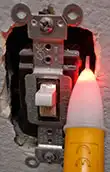
- With power on, remove the cover from the switch and turn the switch off. Using a voltage detector (see picture below), place it next to the terminals on the switch. See if there is voltage at one of the switch terminals. If the tester detects voltage, turn the switch on and see if voltage is detected at the other switch terminal.
- One terminal (line) will always have voltage and the other will have voltage only when the switch is on. If you only detect voltage at one terminal when the switch is toggled, the switch has probably failed. Sometimes the switch terminals are connected to the back of the switch, and voltage cannot be detected while the switch is inside the electrical box. In this case, proceed to step 3.
- Turn off power to the switch at the circuit breaker. Unscrew the switch mounting screws and pull the switch out of the box enough to access the switch terminals. The switch wires do not need to be disconnected at this time. On a multimeter, select continuity (ohms or audible beep) and place the test leads on the terminals to see if there is continuity when the switch is turned on. If there is no continuity, the switch has failed and needs to be replaced.
Check for voltage on switch terminal
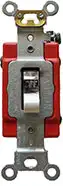
Place leads of continuity tester on the two terminals with power off
How to Troubleshoot a Switched Outlet
If a lamp plugged to a switched outlet does not work, it could be a bad light switch. Below is an example of troubleshooting a lamp with a good bulb that does not turn on.
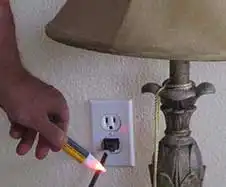
Using an electrical meter, check for power at the switched part of the outlet, or use a voltage detector to see if there is voltage on the lamp cord. Always use a voltage detector on a known good circuit before use to verify the detector is working properly.
If there is power present at the outlet and on the cord, there could be an open circuit in the lamp:
- The lamp switch may be bad
- There is a wiring problem inside the lamp
If there is no power at the outlet or on the cord:
- The light switch may be bad
- There is a loose connection in the circuit
- The outlet may be bad
Notice the burn marks on a failed switch caused by an internal arc flash. If you hear a crackling noise inside the switch, it is caused by internal arcing and is ready to fail.